Real use. Careful testing.
Clearer water advice.
A water filter should earn its place in your home. We look at what it removes, how it works in everyday life, and what it takes to keep it performing.
Two ways we build a review
We conduct physical testing on most products featured in our reviews. Our hands-on process goes beyond unboxing: products are installed, used and, in most cases, reviewed over several months. We look for the details that only become apparent with time, from changing spray performance to cartridge access, leaks and the cost of upkeep.
When we cannot obtain or physically test a product, our team builds a research-based assessment through a thorough review of third-party sources, manufacturer documentation, published test results and owner experiences. We distinguish those findings from our own observations.
Each article should identify which products we physically tested, which we assessed through research, and the conditions and duration of any testing. A research-based comparison does not become a hands-on review simply because we discuss someone else’s test.
Practical tools. The right question.
We combine straightforward, established testing methods with more advanced measurements when the question calls for them. Depending on the product, our toolkit includes TDS meters, digital chlorine readers, reagent-based chlorine comparisons and, in selected cases, paid laboratory analysis.
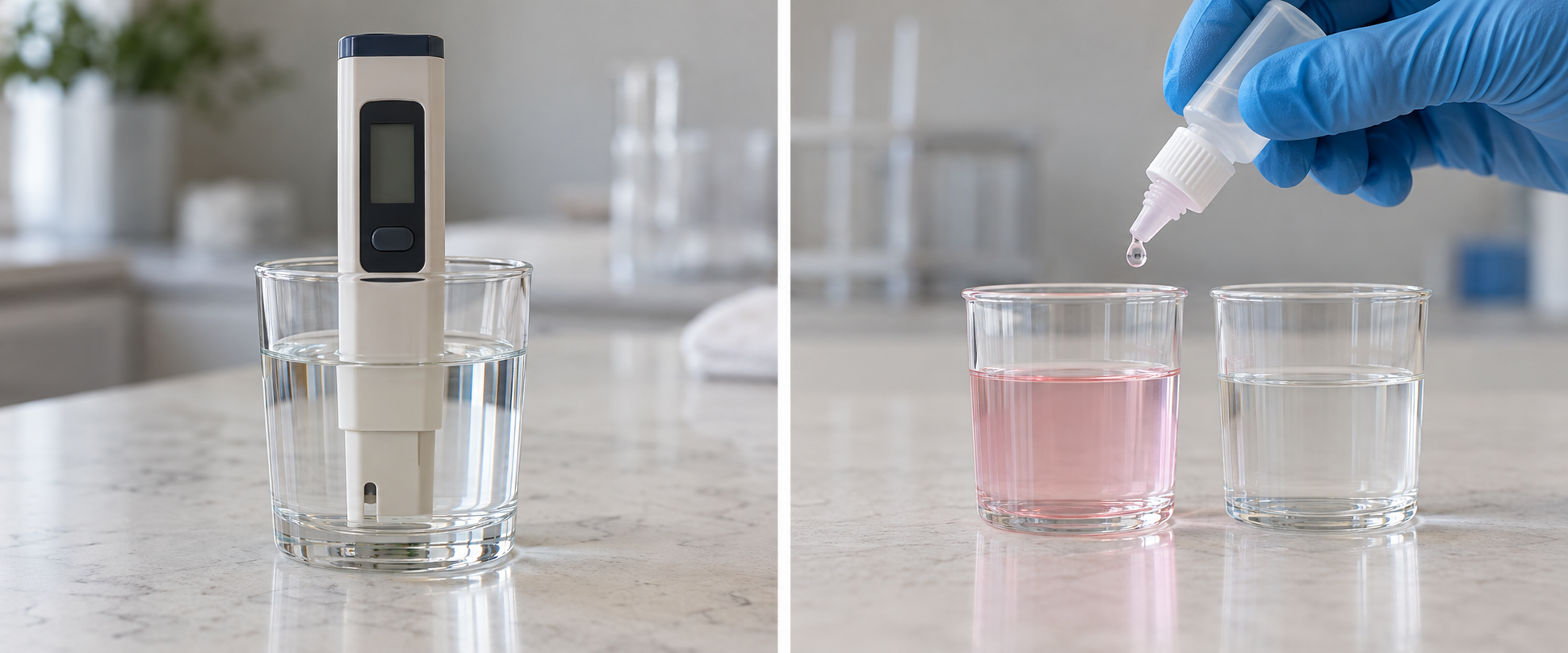
TDS meters: a useful reading, with limits
A handheld TDS meter estimates dissolved solids from conductivity. It can help assess changes in dissolved-ion content, particularly when evaluating reverse-osmosis systems. It does not identify individual contaminants or prove that water is safe. A chlorine-reducing shower filter can work without lowering TDS, so we do not use TDS as a universal filtration score.
Digital chlorine readers and reagent comparisons
For chlorine-focused products, we compare untreated and treated samples using an appropriate chlorine method. Digital colorimeters provide numerical readings; reagent-based comparisons can make a color difference visible. With DPD chemistry, chlorine produces a pink color. Free chlorine and total chlorine are different measurements, and timing, temperature, reagent choice and the instrument’s range matter. A photograph of two cups alone does not establish a removal percentage or performance over a cartridge’s lifetime.
Laboratory analysis when it matters
In selected cases, we commission paid lab reports for specific contaminants that a handheld meter cannot establish. We look at the analytes measured, sampling conditions, detection limits and before-and-after results. We distinguish reports we commissioned from manufacturer-supplied reports and third-party testing. A single sample is a result under those conditions, not a guarantee for every home.
Reviewers who know what to look for
Our editors are trained product reviewers who assess water products beyond their marketing claims. They look at filtration media, the exact contaminants targeted, testing methods, certification scope, installation, flow, build quality and maintenance. They also separate measurable results from subjective observations such as feel, appearance and convenience.
During longer-term use, we pay attention to what changes: whether flow falls, fittings leak, spray holes clog, cartridges become difficult to replace, and ongoing costs match the advertised plan. We do not assign a months-long testing history to a product unless that work was actually completed.
What you should find in our coverage
- The exact product model and when prices and specifications were checked.
- A clear distinction between hands-on observations, manufacturer claims and third-party evidence.
- The relevant measurements and testing limitations, rather than one score applied to every water problem.
- Practical tradeoffs: compatibility, installation, maintenance, refill costs and everyday use.
- Disclosures of ownership, affiliate relationships and supplied samples.